
Every week, someone somewhere is staring at a 60-day-old open role and asking the same question: Why is this taking so long?
The immediate answer is usually wrong. It’s not the market. It’s not that your recruiters aren’t moving fast enough. And it’s almost never that great candidates don’t exist.
The real answer is less dramatic, and harder to fix, precisely because it’s invisible. Your team is operating inside a system where nobody can see the full picture at the same time. And when nobody can see, nobody can move.
The Myth of the Slow Recruiter
There’s a story organizations tell themselves about slow hiring. It goes something like this: the pipeline ran dry, the team dropped the ball, or the role is just too hard to fill. It’s a story that puts the problem on people, on performance, on effort, on individual accountability.
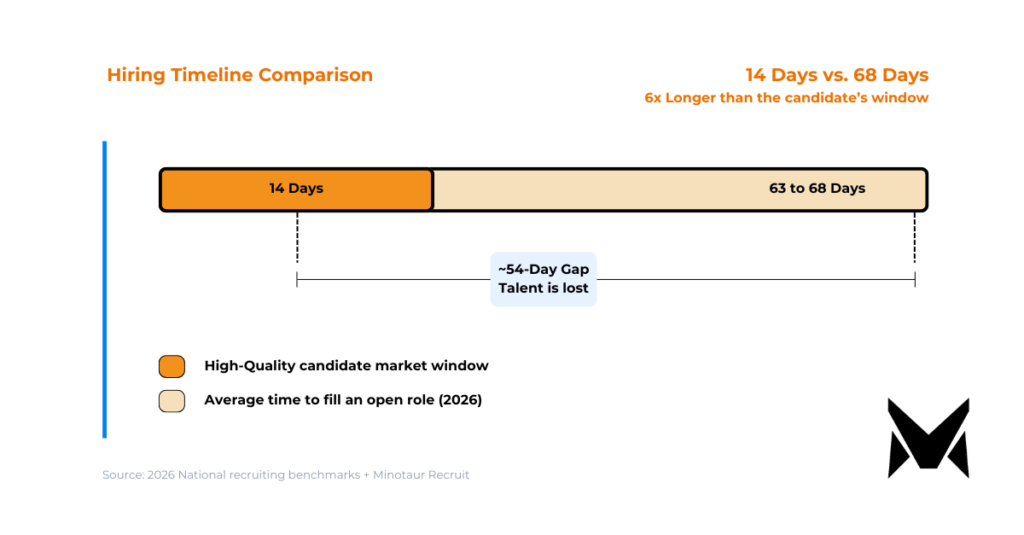
Here’s the part that rarely makes it into the debrief: as of early 2026, the national average time to fill an open position sits between 63 and 68 days. That number has nearly doubled in three years. Meanwhile, high-quality candidates stay available on the market for an average of just 14 days before accepting an offer elsewhere.
To be clear: those are averages. Real timelines vary enormously depending on market size, seniority level, required certifications, and the depth of the talent pool you’re drawing from. Finding a bilingual specialist with a postgraduate degree in a mid-sized city is a fundamentally different challenge than filling a high-volume entry-level role in a major metro. The variables are real, and experienced recruiters know this better than anyone.
But that’s exactly the point. When a process is already complicated by external factors, the last thing a team needs is internal friction making it worse. The benchmark number isn’t a verdict on your team, it’s a floor. The question is how much of the gap between where you are and where you could be is being created by your own systems.
You do the math.
If your process takes two months and the candidate’s window is ten days, you’re not losing to your competition in the final round. You’re losing before you even knew you were in a race.
That’s not a recruiter problem. That’s a systems problem.
Where the Time Actually Goes
The instinct to blame individuals is understandable. It’s harder to diagnose a process than it is to identify a person. But the evidence points clearly at the infrastructure, not the team.
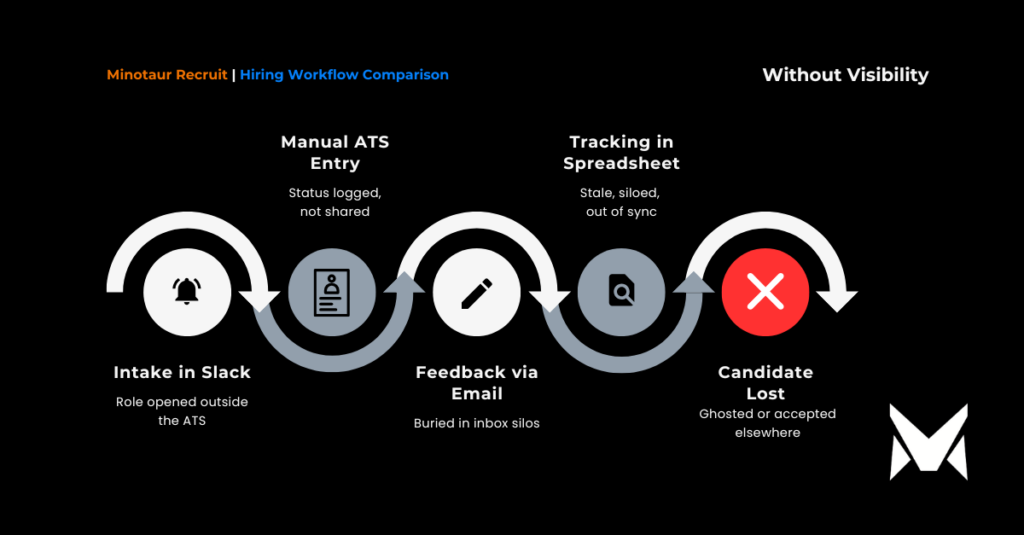
Consider how most recruiting cycles begin: not inside the ATS, but somewhere around it. A Slack message. An email chain. A spreadsheet someone copied from last quarter. The intake data lives outside the system, which means the moment a role opens, the downstream process is already behind.
From there, it compounds. Teams operating across fragmented tools report that moving a candidate from application to first interview takes an average of 7.2 days. That’s not scheduling complexity, that’s the cost of having scheduling, feedback, and approvals living across platforms that don’t communicate with each other.
Then there’s the terminology problem that almost nobody talks about: one team calls it a “Phone Screen.” Another calls it a “Recruiter Call.” A third logs it as “Initial Interview.” Without a shared taxonomy across the ATS, cross-team pipeline tracking becomes impossible. You can’t measure what you can’t agree on.
The result? Recruiting teams in 2026 are managing roughly 40% more open roles than they were a few years ago. They are doing it with manual follow-ups, status meetings, and systems that were never built to scale this way.
The Visibility Gap Has a Human Cost
Slow processes don’t just frustrate operations teams. They frustrate the people on the other side of the process.
57% of job seekers say they lose interest in a role if the process feels too long. 31% have turned down a formal job offer specifically because of poor communication or extended silence during the interview cycle. And 61% of candidates report being ghosted, not by unethical companies, but by teams that genuinely lost track of where that candidate’s file was sitting across three different platforms.
Ghosting isn’t usually a culture problem. It’s a visibility problem.
When communication histories live inside individual recruiter inboxes instead of a shared system, every team absence, every internal transition, every unexpected handoff becomes a risk. The dropped baton isn’t the exception. It’s the structure.
What Visibility Actually Solves
Visibility doesn’t mean surveillance. It means that everyone who needs to act on information can access it when it matters, without needing to schedule a meeting to find out where things stand.
In practice, it means three things:
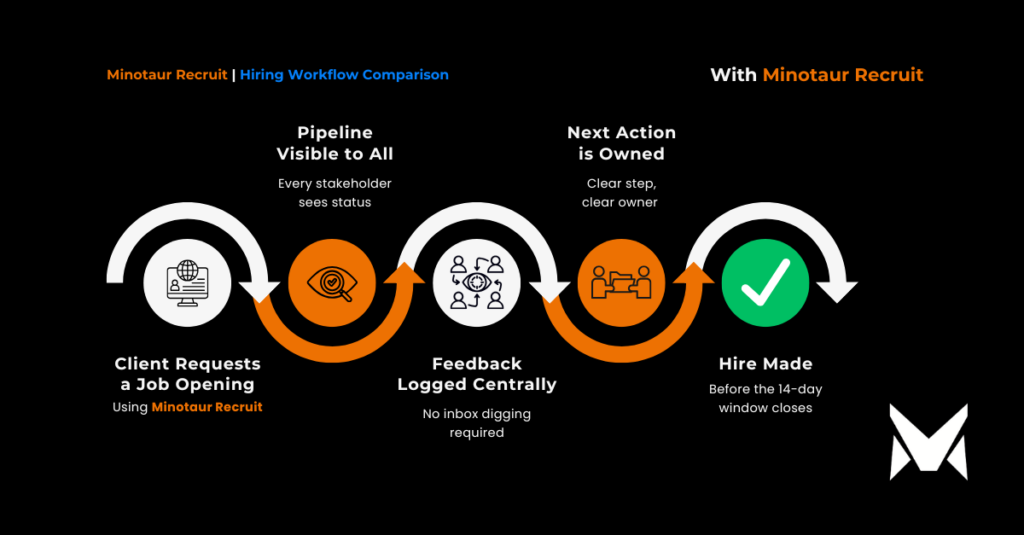
Pipeline clarity in real time. Instead of asking “where is this candidate?” the answer is already visible to everyone involved: account managers, coordinators, decision-makers. The next action is clear. The owner is clear.
Communication that doesn’t depend on any single person. When updates, client feedback, and candidate responses are logged centrally, the process doesn’t stall because someone is out of office. Another team member can step in without starting over. The candidate doesn’t have to explain themselves again.
Standardization that makes measurement possible. When stage names, status updates, and process steps are consistent across the organization, you can actually see where candidates stall. You can fix bottlenecks instead of guessing at them.
That shift, from reaction to execution, is where operational velocity actually comes from. Speed isn’t a personality trait. It’s what happens when the process stops working against itself.
Minotaur Recruit Was Built for This Problem
Minotaur Recruit gives talent acquisition teams a centralized candidate pipeline where every interaction, every status update, and every handoff is logged and visible to the people who need it. No more status meetings to figure out where a candidate stands. No more dropped processes because a recruiter changed roles.
The platform brings hiring coordination into one place, so the process moves at the speed the role demands, not at the speed of whoever remembered to send the last update.
If your team is managing a 60-day pipeline and wondering where the time goes, the answer is probably in the seams between your systems.
That’s exactly where Minotaur Recruit starts.
Ready to see what’s possible when your hiring pipeline has no blind spots?
Join the Minotaur Early Access Program and learn how Minotaur Recruit is helping organizations transform recruiting operations through connected workflows and verified candidate data.
Navigating the Labyrinth: Modern Buying Behavior
Why do hiring processes take longer even when recruiters work faster?
Because speed is limited by systems infrastructure rather than manual effort. Fragmented tools, isolated communication silos, and undefined stage taxonomies create invisible internal delays.
Why is recruitment visibility critical for candidate retention?
Visibility prevents candidates from dropping out due to long periods of silence or process fragmentation. It ensures that multiple internal stakeholders can track timelines and maintain momentum synchronously.
How does centralized coordination accelerate the time to fill?
Centralizing feedback, client updates, and pipeline staging into a single environment removes communication blockages and eliminates the need for alignment meetings.
Minotaur Recruit is designed for teams that need complete pipeline transparency before candidate momentum is lost.