
For many sales teams, a stalled pipeline immediately points toward a messaging problem. When response rates decline, the natural reaction is to review the elements that appear easiest to influence: the subject lines being tested, the personalization approach, the opening message, or the cadence of the outreach sequence. These adjustments are important because messaging plays a critical role in creating engagement, but they also assume that the message is reaching the right person in the first place.
In many B2B organizations, the real problem happens earlier than most teams realize. Before a prospect decides whether an email is relevant, before they evaluate the offer, and before they choose whether to respond, another decision has already been made: whether the email will successfully reach their inbox at all.
This is the overlooked impact of poor contact data.
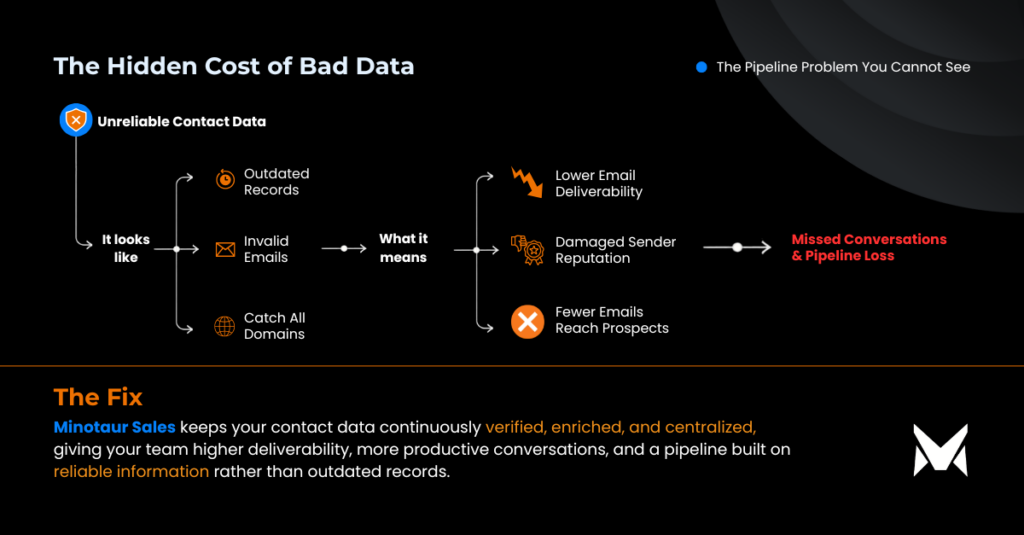
A sales team can spend hours researching accounts, crafting personalized messages, and building thoughtful outreach strategies, but if the underlying data is outdated, incomplete, or inaccurate, those efforts are compromised before the conversation even begins. The issue is not simply that some emails bounce. Unreliable contact data creates a chain reaction that affects deliverability, sender reputation, sales efficiency, and ultimately pipeline performance.
The Hidden Foundation Behind Every Successful Outreach Strategy
Outbound sales performance is often measured by visible outcomes: open rates, reply rates, meetings booked, and opportunities created. These metrics are valuable, but they only reflect what happens after a message enters the delivery process. The foundation underneath those outcomes is the quality of the data powering the outreach.
B2B contact information naturally changes over time. People move into new roles, companies restructure departments, organizations merge or close, and email domains become inactive. Research across the industry suggests that B2B databases experience annual decay rates between approximately 22% and 30%, meaning a significant portion of contact information becomes outdated every year, even when a company has invested heavily in building its database.
This creates a challenge many sales organizations underestimate. A database that was accurate when it was created does not automatically remain accurate months later. Without continuous maintenance, teams are often operating from information that quietly loses value while still appearing complete. The result is a dangerous illusion: a large database that creates the appearance of sales capacity but does not provide the reliability needed to support consistent outreach.
As outbound strategies become more sophisticated, the difference between having more contacts and having better data becomes increasingly important. More volume does not solve unreliable information. It simply increases the number of inaccurate records being activated.
Deliverability Is a Sales Infrastructure Issue, Not Just an Email Issue
When teams think about email deliverability, they often associate the problem with technical email settings or marketing operations. However, for modern sales organizations, deliverability has become a direct business performance factor because every email sent contributes to a sender reputation that mailbox providers use to evaluate future communication.
High bounce rates, repeated delivery failures, and poor data quality signals reduce trust with providers, making it increasingly difficult for future messages to reach legitimate prospects. This creates one of the most frustrating scenarios for sales teams: even when the messaging improves, performance may continue to decline because the underlying sending reputation has already been affected.
A campaign can have strong personalization, a well defined audience, and a compelling offer, but if a significant percentage of the contact list contains invalid or unreliable records, the campaign begins with a disadvantage. The problem becomes even more complex with catch all domains. These domains are configured to accept incoming emails at the server level, even when a specific mailbox may not exist. Traditional verification processes can identify these addresses as deliverable because the domain accepts the message, but the actual delivery failure may only appear after the email has already been sent.
By that point, the sales team has already invested time into researching the contact, creating the message, and launching the campaign, while the sender reputation has already absorbed the negative impact.
Why Messaging Optimization Alone Cannot Fix a Data Problem
One of the biggest mistakes sales teams make is assuming that declining outreach performance always requires better messaging. While stronger copy, more thoughtful personalization, and improved sequencing can certainly influence engagement, those efforts only begin to matter after an email reaches its destination. When unreliable contact data prevents that message from arriving in the first place, even the strongest outreach strategy is operating at a disadvantage.
This explains why many organizations struggle to improve pipeline performance despite continuously refining their sales playbooks. They focus on optimizing the most visible part of the process because it feels measurable and actionable, while the underlying issue remains untouched. Better messaging cannot recover opportunities that were never delivered, nor can it repair the sender reputation damaged by poor quality data. Before teams ask how to improve their outreach, they should first ask whether their outreach is consistently reaching the right people.
From Data Maintenance to Revenue Infrastructure
For years, organizations have treated contact data as something that requires occasional maintenance. Lists are exported, databases are cleaned, new records are purchased, and the cycle repeats whenever performance begins to decline. That approach may have been sufficient when outbound sales relied primarily on volume, but it no longer supports the level of precision expected from modern revenue teams.
Contact information changes every day, not every quarter. Professionals move into new roles, companies restructure, domains change, and organizational hierarchies evolve continuously. As a result, data quality cannot be managed through periodic cleanup exercises alone. It requires an operational approach that keeps information current as sales teams work, ensuring that every campaign begins with the highest possible level of confidence.
This shift represents more than better database management. It reflects a broader change in how organizations think about revenue operations. Rather than viewing contact data as a static asset, leading sales teams are beginning to treat it as infrastructure, recognizing that every stage of the sales process depends on the reliability of the information beneath it.
Building Revenue on Better Data
Organizations have invested heavily in CRM platforms, automation software, AI powered workflows, and increasingly sophisticated sales processes. Yet many continue to build those workflows on contact data that begins losing accuracy almost as soon as it enters the system. When that foundation weakens, every layer above it becomes more difficult to optimize, regardless of how much effort is invested in messaging or sales execution.
Minotaur Sales was built to address that challenge by giving revenue teams access to a continuously verified ecosystem where contact information is enriched, maintained, and shared across the organization. Instead of relying on disconnected databases that require constant manual maintenance, sales teams can work from a single source of truth that strengthens deliverability, improves operational efficiency, and supports more confident decision making throughout the sales process.
As outbound sales continues to evolve, the organizations that consistently outperform their competitors will not necessarily be those sending the highest volume of emails. They will be the ones building their revenue operations on information they can trust, allowing every campaign, every sequence, and every conversation to begin with greater confidence.
If your sales team is spending more time correcting contact data than creating opportunities, the challenge may not be your outreach strategy. It may be the infrastructure supporting it.
The future of outbound sales will not be defined by who sends the most emails. It will be defined by who builds the strongest foundation before outreach ever begins.
Join the Minotaur Community on LinkedIn for daily insights on sales infrastructure, verified data, revenue operations, and the systems helping modern organizations sell with greater confidence.
If you’re ready to strengthen the foundation behind your sales pipeline, request early access to Minotaur Sales and discover how continuously verified data can help your team spend less time fixing records and more time building relationships that drive revenue.
Navigating the Labyrinth: Modern Buying Behavior
Why are sales reps spending less than half their week actually selling?
Because administrative burdens and software fragmentation consume the vast majority of their operational capacity. Constant navigation between siloed databases, CRMs, and email sequences acts as a persistent drain on productive momentum.
Why does the toggle tax have a deeper cognitive cost than just lost minutes?
Because tool switching breaks psychological concentration. Every time a professional switches contexts, it triggers attention residue that delays full re engagement with the core sales task for more than twenty minutes.
How does workspace consolidation improve operational revenue performance?
Consolidation eliminates the friction of moving across platforms, allowing sales professionals to retain focus and act immediately on intent signals within a singular operational environment.
Minotaur Sales is designed for teams that need to eliminate administrative fragmentation and keep reps focused on revenue generation.