
Ask a sales leader why a team is missing quota, and the answer almost always lands on the rep. Not enough calls. Not enough follow up. Not enough hustle. It’s a comfortable theory, because it comes with an easy fix: hire better, coach harder, apply more pressure.
The data doesn’t back that up.
According to Salesforce’s 2026 State of Sales report, reps spend just 40% of their week on tasks that actually generate revenue. The other 60% goes to updating records, sitting in internal meetings, and hunting for the right piece of content to send a prospect. Field sales tells a similar story: SPOTIO’s 2026 State of Field Sales research puts selling time slightly higher, at 43%, but pins down exactly where the rest disappears: 21% of the week, or roughly 8 hours per rep, goes straight into administrative work. Multiply that across a 10 person team and you’ve lost more than 4,000 hours a year. Not to a slow market. To paperwork.
That’s not an effort problem. It’s a workflow problem, and it has a name.
The Toggle Tax
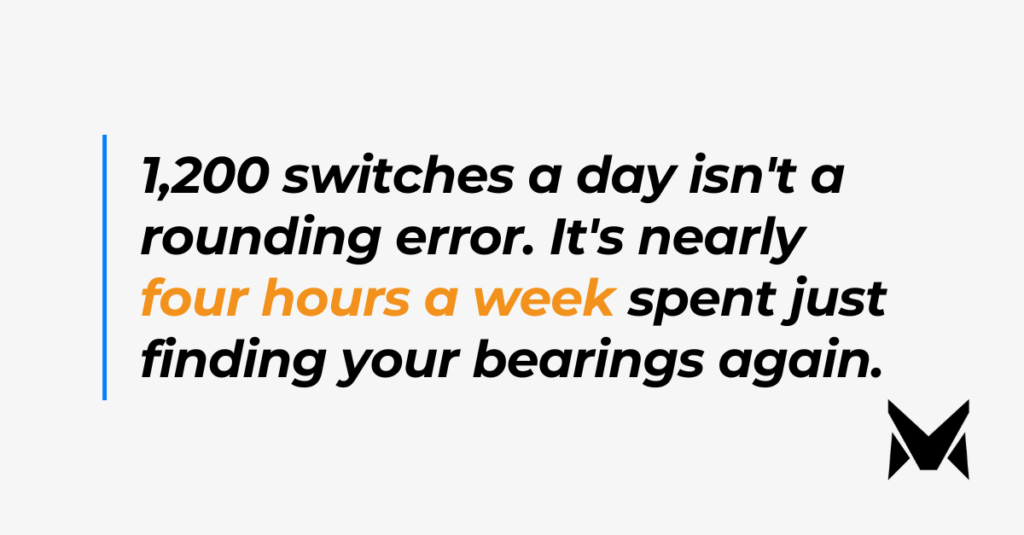
In 2022, Harvard Business Review researchers tracked 137 employees across three Fortune 500 companies and found something that’s only gotten more relevant since: the average worker switches between digital applications around 1,200 times a day. Each switch costs more than the second or two it takes to click over. The same research found that this constant toggling eats up about 9% of the entire workday; close to four hours a week spent purely on re navigating between disconnected tools, not doing the work itself.
For an SDR, that means bouncing between a CRM, an email client, a sequencing tool, and a prospecting database isn’t a minor inconvenience. It’s a structural tax on every single outreach cycle.
Why Switching Costs More Than It Looks Like
The toggle tax isn’t just about time spent clicking between tabs, it’s about what happens to focus once you land in the new one. Research from the University of California, Irvine found that after an interruption like switching tools or searching for missing data, it takes an average of over 23 minutes to fully regain the same depth of concentration.
Stack that against 1,200 switches a day and the math stops being about minutes lost and starts being about how rarely a rep ever reaches real focus at all. A call gets interrupted by a CRM update. The update requires a lookup in a separate database. The lookup surfaces outdated contact info, which triggers a detour to verify it somewhere else. By the time the rep returns to the original task, the moment that mattered, the one where a prospect showed real interest, has often already passed.
The Reframe
None of this shows up on a scorecard. A rep who spent four hours reorienting between tools this week looks, on paper, identical to a rep who spent four hours in genuinely unproductive meetings. Both numbers just say “not selling.” But only one of those problems responds to coaching. The other responds to removing the friction between systems that were never built to talk to each other.
This is why sales productivity conversations that start and end with rep behavior tend to plateau. The bottleneck usually isn’t skill, script, or motivation, it’s how much of the day gets consumed just keeping five different systems in sync with each other.
Where This Leaves Sales Teams
Fixing this doesn’t mean adding another tool to the stack, that just adds another switch. It means reducing how many places a rep’s attention has to travel before they can act on something.
Minotaur Sales was built around that principle: prospecting, outreach, and pipeline data live inside the same workspace, so a rep tracking a conversation doesn’t have to leave it to find the context they need to move it forward.
The 60% isn’t a mystery anymore. It’s measurable, and it’s mostly recoverable, not by asking reps to do more, but by giving back the hours currently lost to systems that were never designed to work together.
That 60% doesn’t have to stay lost. Early access to Minotaur Sales is open now, see what a day looks like when your reps aren’t fighting their own stack. Visit earlyaccess.minotaur.io to learn more.
Navigating the Labyrinth: Modern Buying Behavior
Why are sales reps spending less than half their week actually selling?
Because administrative burdens and software fragmentation consume the vast majority of their operational capacity. Constant navigation between siloed databases, CRMs, and email sequences acts as a persistent drain on productive momentum.
Why does the toggle tax have a deeper cognitive cost than just lost minutes?
Because tool switching breaks psychological concentration. Every time a professional switches contexts, it triggers attention residue that delays full re engagement with the core sales task for more than twenty minutes.
How does workspace consolidation improve operational revenue performance?
Consolidation eliminates the friction of moving across platforms, allowing sales professionals to retain focus and act immediately on intent signals within a singular operational environment.
Minotaur Sales is designed for teams that need to eliminate administrative fragmentation and keep reps focused on revenue generation.