
It is 8:17 on a Tuesday morning when the email arrives.
“I’ve accepted another opportunity. My last day will be in two weeks.”
Within minutes, the organization shifts into motion. The hiring manager wants the position posted immediately. HR begins reviewing the job description. Recruiters reopen sourcing platforms and notify external agencies that another search is about to begin. For many organizations, this sequence is so familiar that it feels almost automatic. What rarely receives the same attention is a much more important question: Why are we starting from zero again?
Employee turnover is not an unexpected event. People retire, relocate, accept promotions, and pursue new opportunities every day. Organizations know that critical positions will eventually become vacant, yet many continue to treat every resignation as though it were an unforeseen crisis. The vacancy itself isn’t the surprise. Starting every search from scratch is.
That mindset has quietly become one of the most expensive habits in modern recruiting. Instead of viewing hiring as an ongoing business function, organizations often approach it as a series of isolated events.
Every vacancy triggers a new sourcing effort, while years of candidate relationships, interview feedback, and recruiter knowledge remain buried inside applicant tracking systems. Candidate data becomes an archive rather than a strategic asset, forcing recruiters to solve the same problem repeatedly.
Employee turnover is inevitable. Starting every search from zero is a choice.
When Recruiting Becomes Emergency Response
Imagine Sarah, a Director of Talent Acquisition at a growing organization. She’s managed dozens of successful hires throughout her career, yet every new vacancy feels remarkably similar. A hiring manager requests immediate support, recruiters begin sourcing candidates from scratch, and interview schedules quickly fill. The pressure isn’t simply to find the right person. It’s to do it as quickly as possible.
As Sarah prepares to launch another search, she remembers a candidate who reached the final interview eighteen months earlier. The hiring team spoke highly of him. His technical assessment was excellent, his cultural fit was strong, and the decision ultimately came down to another candidate with slightly more experience. Somewhere inside the company’s ATS are interview notes, recruiter feedback, and hours of evaluation that could still hold tremendous value.
Finding him, however, isn’t simple. His profile hasn’t been updated, his skills may have evolved, and there’s no easy way to determine whether he’s still available or interested in a new opportunity. Despite already investing significant time evaluating someone who could be an excellent fit, Sarah begins the search all over again. Not because she wants to, but because the system leaves her no alternative.
This is where reactive recruiting becomes an operational problem rather than simply a recruiting challenge. The issue isn’t a shortage of talent. Most organizations have already invested thousands of hours building relationships with qualified candidates. The real problem is that very little of that investment remains accessible when the next opportunity appears.
The Financial and Operational Cost of Starting From Scratch
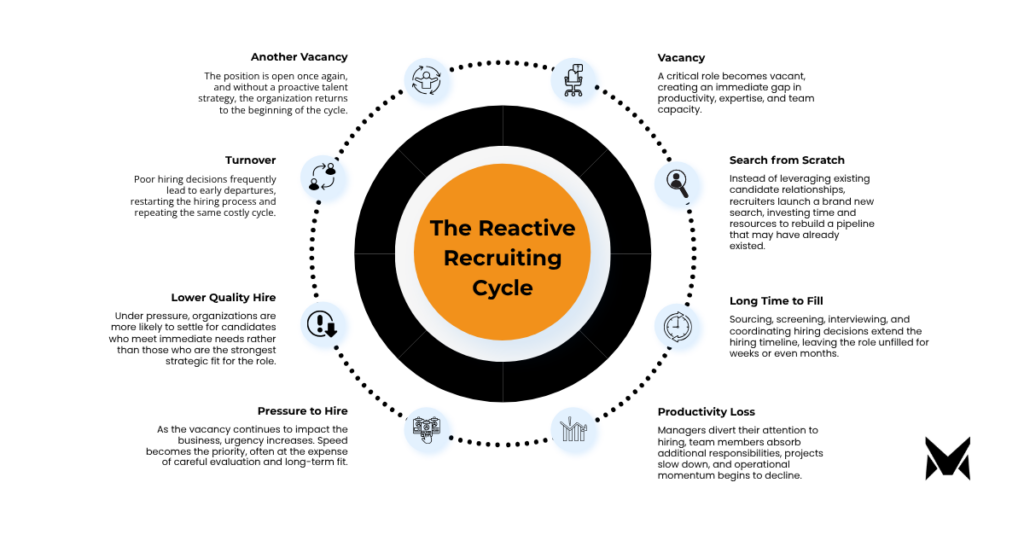
Operating in perpetual hiring emergencies carries consequences that extend far beyond the recruiting team. According to the HR Research Institute, more than half of organizations still rely primarily on just in time recruiting, only beginning to search for candidates once a vacancy becomes urgent. While this approach may seem unavoidable, it creates a chain reaction that affects productivity, execution, hiring quality, and ultimately business performance.
The first cost is often invisible. An open position doesn’t simply leave one seat empty. Managers spend valuable time reviewing resumes, conducting interviews, and coordinating hiring activities instead of leading their teams. Existing employees absorb additional responsibilities, increasing workloads and creating conditions for burnout. Projects slow as specialized knowledge becomes temporarily unavailable, and organizational momentum begins to erode. According to SHRM, every month a position remains vacant costs organizations between $4,000 and $9,000 in lost productivity, delayed initiatives, and reduced operational efficiency.
The longer organizations wait to begin identifying talent, the longer these disruptions continue. The 2026 Ashby Talent Trends Report found that the median time to first fill has reached 56 days for business roles and 76 days for technical positions. Waiting two or three months to replace a critical employee is no longer simply a recruiting metric. It represents an operational bottleneck that delays projects, limits capacity, and places sustained pressure on the rest of the organization.
Time pressure also changes the quality of hiring decisions. When business leaders urgently need someone in the role, speed often becomes the dominant objective. Research from Gartner indicates that organizations relying primarily on reactive hiring experience significantly lower quality of hire than those maintaining proactive talent ecosystems. Rather than selecting the strongest candidate available, organizations frequently settle for the strongest candidate available within the shrinking window they have created.
Unfortunately, the costs rarely end when the position is filled. Rushed hiring decisions are more likely to result in poor long term fit, leading to turnover that forces the entire process to begin again. The U.S. Department of Labor estimates that replacing a bad hire costs at least 30% of that employee’s first year earnings, while SHRM estimates replacement costs for many professional and managerial roles can reach 150% of annual salary. What begins as a single vacancy quickly becomes an expensive cycle of repeated sourcing, interviewing, onboarding, and replacement.
Every cycle begins with a vacancy, but it continues because organizations repeatedly rebuild what they should have been continuously maintaining. Pipeline Continuity breaks this loop before it starts.
Pipeline Continuity: A Better Way to Think About Recruiting
Manufacturers don’t wait until inventory runs low before establishing supplier relationships. Sales organizations don’t begin prospecting only after missing quarterly revenue targets. IT departments don’t create backup systems after a server fails. Operational resilience depends on continuity, preparation, and systems designed to anticipate inevitable business events. Recruiting should operate under the same principle.
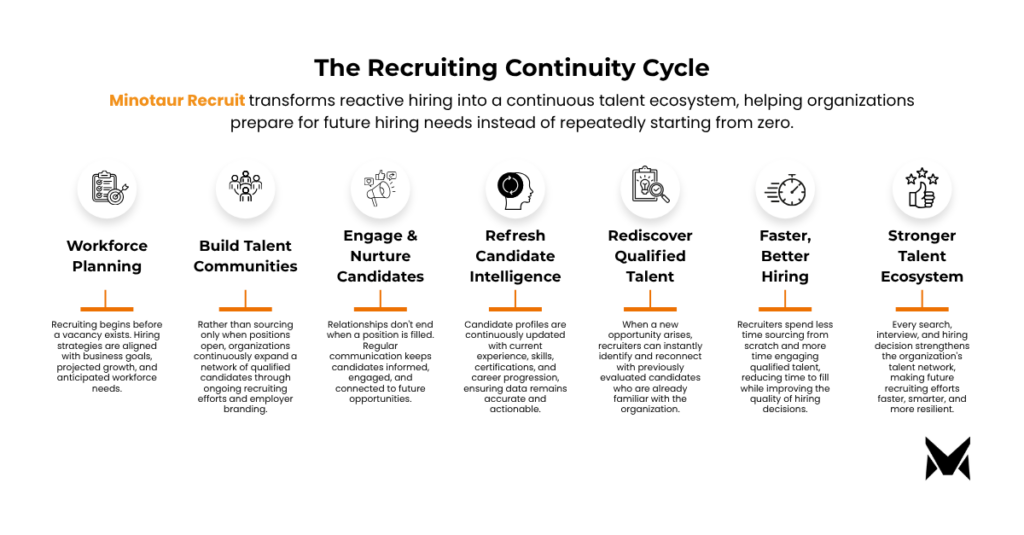
Instead of viewing hiring as a sequence of disconnected searches, organizations should think in terms of Pipeline Continuity: maintaining a living ecosystem of qualified talent before specific vacancies exist. This shifts the objective from reacting to openings toward preparing for them, ensuring that every search begins with existing relationships rather than cold outreach.
Pipeline Continuity recognizes that every interview, every application, and every candidate conversation is an investment. Some candidates may not receive an offer today, but that doesn’t diminish their potential value tomorrow. Organizations that preserve and continuously strengthen those relationships build institutional recruiting memory, allowing every hiring effort to benefit from the work that came before it instead of starting from zero.
Build Recruiting Continuity with Minotaur Recruit
Organizations cannot eliminate employee turnover, but they can eliminate the operational disruption that follows it. Every interview completed, every candidate assessed, and every relationship built represents an investment. Allowing that investment to sit dormant until another vacancy appears means paying for the same work repeatedly.
Minotaur Recruit was built to help organizations move beyond reactive recruiting by transforming historical candidate data into a living, continuously evolving talent ecosystem. Through AI powered candidate rediscovery, dynamic profile updates, and predictive talent mapping, teams can begin every search with qualified, familiar talent instead of starting from scratch.
The organizations that will hire faster over the next decade won’t necessarily be the ones posting jobs first. They’ll be the ones that never stopped building relationships.
It’s time to stop treating every vacancy like a new beginning and start building recruiting continuity.
Ready to stop starting from zero?
Minotaur Recruit is currently accepting Early Access applications from organizations looking to modernize their recruiting strategy and build a continuously connected talent ecosystem before their next critical hire.
Join the Early Access program today and discover how Minotaur Recruit can help your team reduce time to fill, improve hiring quality, and turn every candidate interaction into a long term recruiting advantage.
The first conversation is no longer the beginning. It is the continuation of something already in motion.
Navigating the Labyrinth: Modern Buying Behavior
Why are candidates speaking to recruiters later in the process?
Because modern professionals can thoroughly research, compare, and validate prospective employers independently through digital channels before engaging with recruiting teams directly.
Why is intent detection important in modern recruiting?
Intent detection helps talent teams identify early availability and career progression signals, vastly improving timing, prioritization, and candidate engagement before vacancies disrupt operations.
How is AI changing talent acquisition strategy?
AI helps recruiting teams analyze historical data patterns, connect fragmented talent signals, and discover qualified candidates within their existing database much faster than legacy tracking systems allow.
Minotaur Recruit is designed for teams that need visibility into candidate intent before the traditional search begins.